
Seeing Against Seeing is an artist book created by Alexey Yurenev in collaboration with designer Teun van der Heijden and the Anti-Kriegs-Museum in Berlin. It is one of several outcomes of Silent Hero, a visual research project and historical investigation into Yurenev’s grandfather’s unspoken experience during World War II.
Rooted in the documentary tradition, Yurenev’s practice confronts the challenge of visualizing what cannot be seen: absences in family and state archives, repressed memories, and events without witnesses. If photojournalism shows what could not be observed firsthand, one of generative AI’s more provocative capacities is to imagine what never happened, but could have. It is this speculative potential that draws Yurenev into collaboration with artificial intelligence.
At the heart of the book is a dialogue with Ernst Friedrich’s 1924 anti-war manifesto War Against War!, which used graphic photographs to dismantle war’s heroic image. Yurenev responds by employing a bespoke generative model trained on 35.000 portraits and landscapes of the WWII-era. The resulting synthetic images bear a striking resemblance to Friedrich’s photographs, echoing their visual grammar, yet they do not merely imitate historical evidence. Instead, they peel away the surface of photographic realism, exposing what lies beneath it—the flesh under the skin of the image.
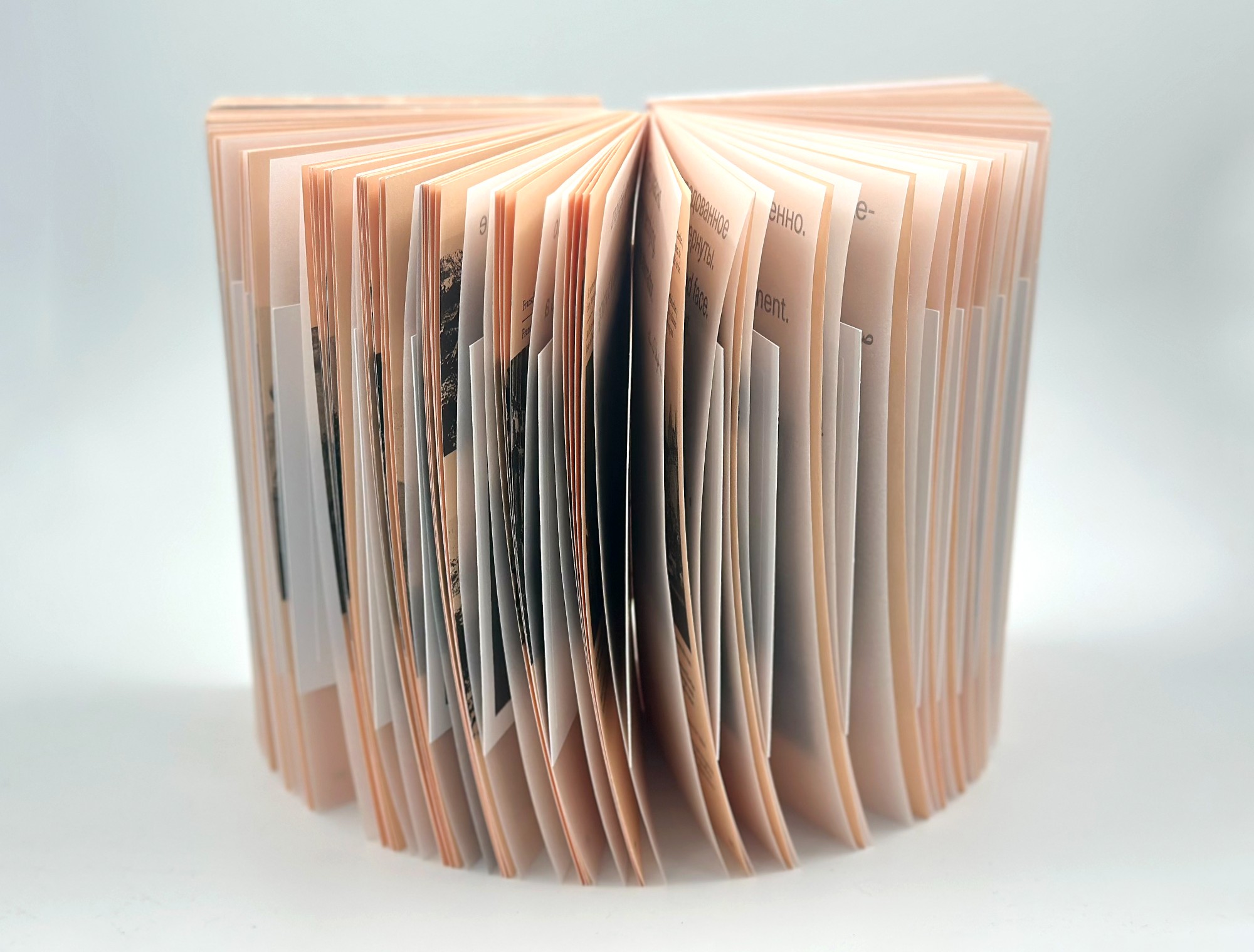
Yurenev printed the generated images manually by using a polymer technique and showed the prints to five Red Army centenarian veterans in Brighton Beach, New York. These veterans, of the same generation as Yurenev’s grandfather are known as the silent generation. The images seem to have the effect of a Rorschach test on these veterans. Their verbal reactions, which are also recorded in the film No One is Forgotten, are interwoven with the images in the book. Although AI is fundamentally statistical, here the reading of abstraction becomes psychological: revealing war’s true face as grotesque.
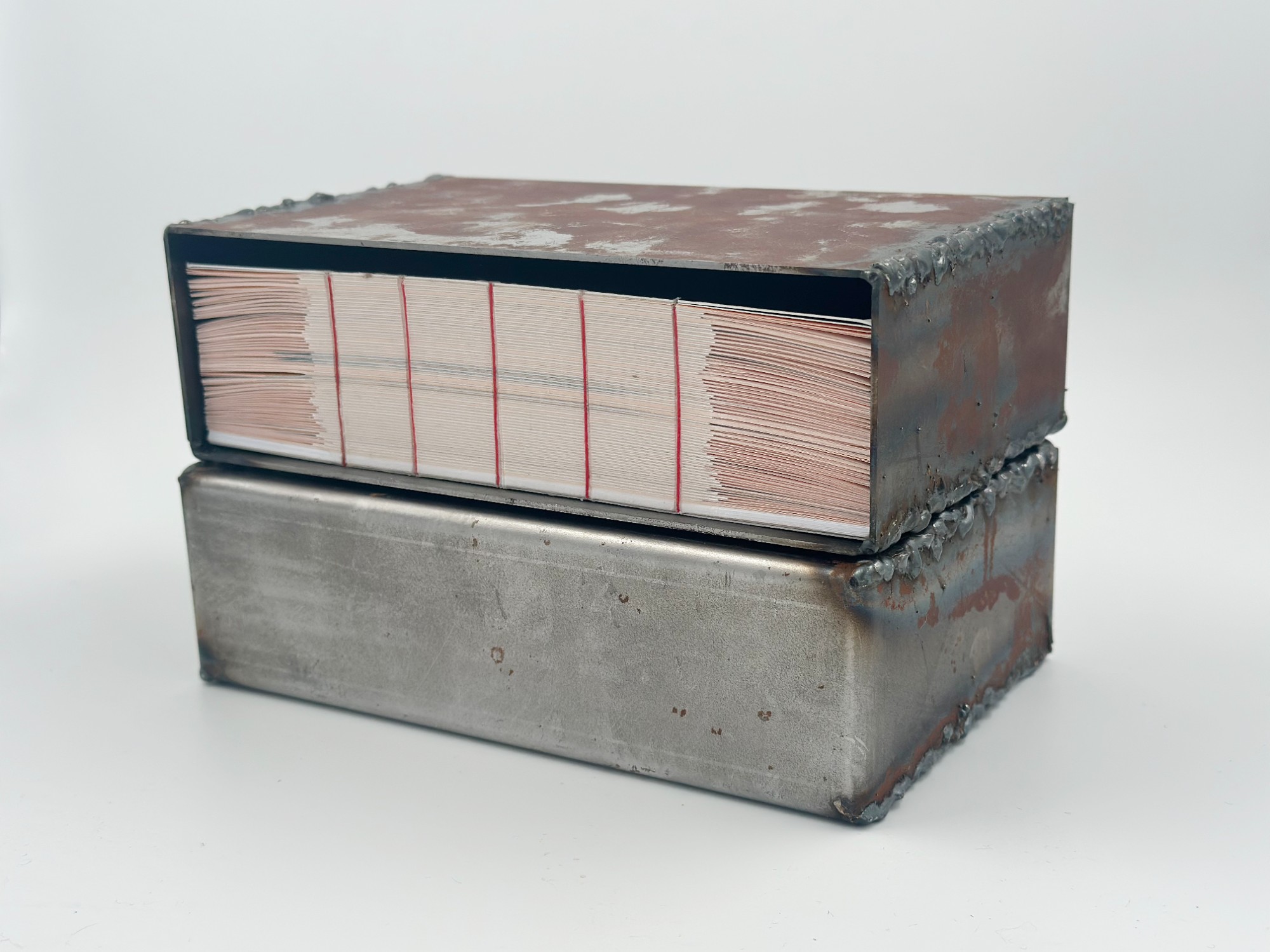
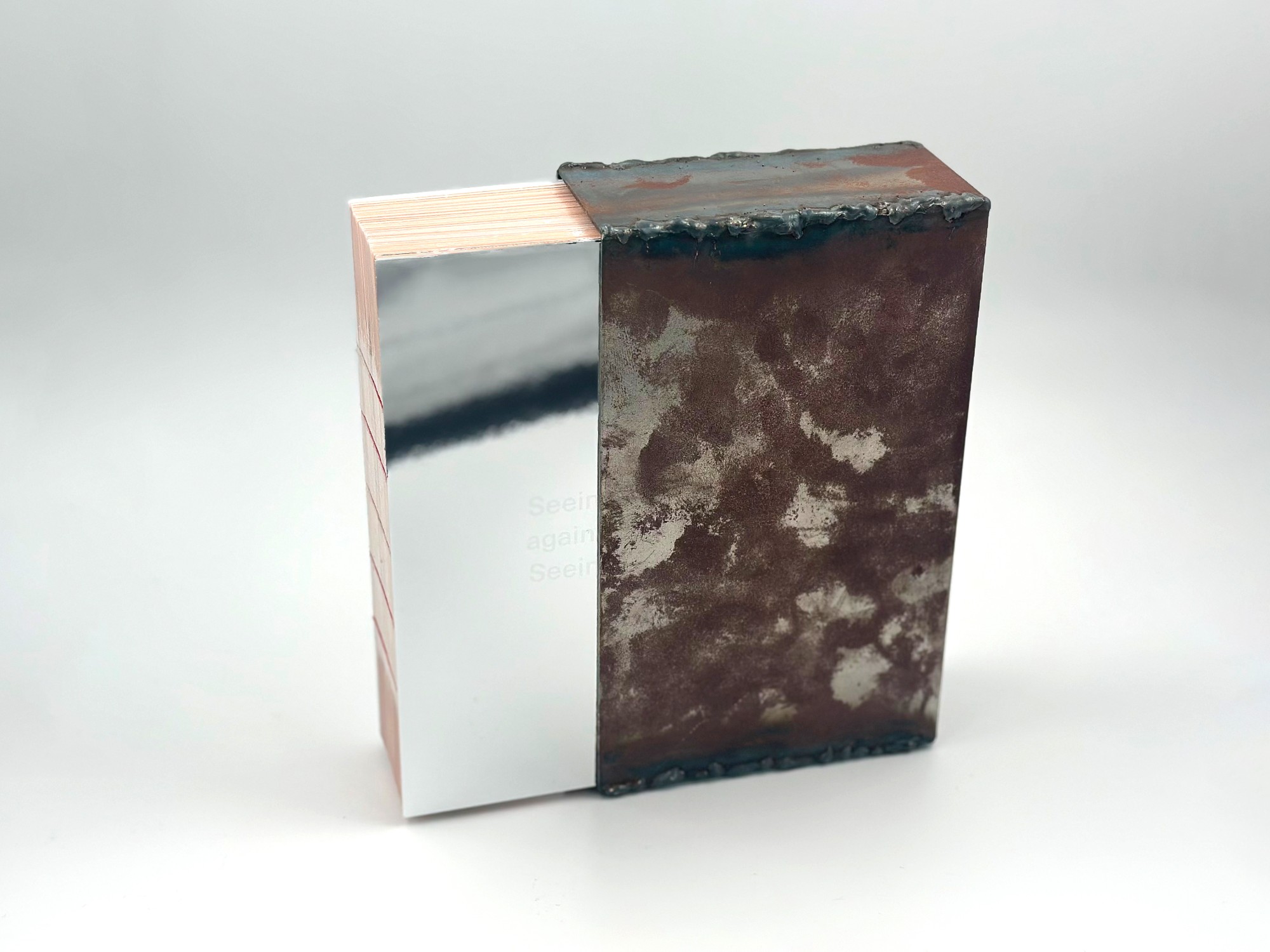
The object is born out of an amalgam of a dissection of an eighties pocket edition of War against War, Yurenev’s polymer prints and the response of the Red Army veterans printed in silver ink on translucent pages. The book block is hand bound and has the appearance of a brick. The object comes in a hand welded iron case that will become rusty over time. The sawing marks on the spine of the book and the welding marks on the iron case appear like scars. The book aims to be a meditation on vision itself: how we see, what remains unseen, and how seeing might be turned against itself.
Nooscope publishes books that center on meditative, introspective visual narratives. While rooted in documentary practice, Nooscope embraces ambiguity, symbolic density and open-ended storytelling. The press produces socially aware, philosophically inclined art objects that operate at the intersection of history, image-making techniques and personal narrative.
Nooscope sees each book as a narrative sculpture. The physical form—its materials, construction, and presence—reflects and interrogates the content it carries, questioning the relationship between medium and meaning, as well as the conditions under which the work is produced and distributed. Though cardboard and paper remain foundational, Nooscope extensively experiments with unconventional materials such as textiles, wood, glass, and iron. Committed to pushing the boundaries of the photobook medium, Nooscope produces genre-breaking objects that sometimes cross into performance or sculpture, like the hybrid of a photobook and a chair. Nooscope books are published in very limited, numbered editions and are distributed directly by the artists.
Nooscope is a collaboration between book designer Teun van der Heijden and artist and visual researcher Alexey Yurenev.
Teun van der Heijden is a graphic designer and co-founder of Heijdens Karwei, a graphic design agency based in Amsterdam that is known for award winning photobooks. Next to running Heijdens Karwei Teun is professor Visual Design and Hybrid media at the LUCA School of Arts in Genk, Belgium and a faculty member of ICP, the International Center of Photography in New York and teaches at the MAPS program [Master Photography and Society] at the KABK [Royal Academy of Arts] in The Hague.
Together with his partner Sandra van der Doelen Teun teaches photo book workshops and masterclasses all over the world.
Teun is author of ‘Of Simple Cells and Visual Associations in Photobook Editing’ an article that is featured in the international open-access peer-reviewed journal Trans Asia Photography Vol. 14, published by Duke University Press.
Alexey Yurenev is an artist, visual researcher, and educator whose work explores the intersections of memory, technology, and production of knowledge. He is Adjunct Faculty in the visual arts MFA Program at Columbia University and a faculty member at the International Center of Photography (ICP). His work has been exhibited internationally at venues including FOAM (Amsterdam), Hangar (Brussels), MOMus Modern/Costakis Collection (Thessaloniki), and Rencontres d’Arles. He is the author of the book Seeing Against Seeing (2025).
Yurenev’s projects have been featured in The New York Times, National Geographic, Literary Hub, and Topic. His work is held in collections such as Johns Hopkins University Special Collections, FOAM Museum, and the Anti-Krieg Museum. He has been recognized by Photographer of the Year International and received the Silurian Society Award for excellence in arts and culture journalism. He has also been nominated for an Emmy Award and the FOAM Paul Huf Award.
He is the co-founder of FOTODEMIC, an online platform for innovative visual strategies, and the founder and executive producer of Living Room, a monthly public program for ICP alumni.
For inquiries:
nooscope.press@gmail.com